Two Worlds, One Table: How Arab-American Families Are Building Holiday Traditions That Belong to Them
For a lot of Arab-American kids growing up in the U.S., the holiday season used to feel like a pop quiz with no right answer. Do you explain Eid to your classmates, or do you just go along with the Halloween costume contest? Do you put up a Christmas tree because your neighbors do, or does that feel like you're drifting too far from home? For years, the conversation defaulted to "either/or." But something has shifted — and it's coming straight from the living rooms, backyards, and family group chats of Arab-American households across the country.
Families aren't waiting for a cultural permission slip anymore. They're blending, layering, and sometimes straight-up inventing traditions that feel true to who they actually are — people with roots in Cairo or Beirut or Amman who also grew up cheering for the Chicago Bulls and eating Thanksgiving leftovers for a week.
Eid That Feels Like a Block Party
Take Nadia and Kareem Haddad, a Lebanese-American couple in Dearborn, Michigan, who have hosted an Eid al-Fitr gathering for the past eight years that their neighbors — Arab and non-Arab alike — now pencil into their calendars months in advance. What started as a modest family iftar has evolved into something that looks, from the outside, a little like the Fourth of July and a lot like a Beirut street festival all at once.
"We have the string lights, the lawn chairs, the coolers," Nadia laughs. "But we also have my mother-in-law's ma'amoul cookies on every table, and my uncle is always doing the call to prayer from the backyard. It's chaotic and beautiful and very us."
Their teenage daughter, Lara, helped design the invitations this year — bilingual, with a crescent moon motif alongside a graphic that looked like it could've come off an Etsy shop. "She wanted her friends to actually come," Kareem says. "And they did. Like, twenty of them."
This kind of cross-cultural hospitality is showing up in Arab-American communities from Houston to Chicago to the suburbs of Northern Virginia. It's not about performing identity for outsiders — it's about Arab families genuinely making their celebrations feel expansive enough to hold everyone they love.
The Christmas Tree That Speaks Arabic
Not every Arab-American family is Muslim, of course. Arab Christians — including significant communities of Coptic, Maronite, and Orthodox backgrounds — have their own complex relationship with American holiday culture. For many of them, Christmas was always part of the picture. But the version of Christmas they inherited from their parents looked and sounded different from what they saw in American department stores.
Rima Aziz, a Syrian-American mom in suburban Atlanta, has spent the last three years decorating her family's Christmas tree with ornaments she hand-paints herself. Some are traditional red and gold. Others are small wooden discs featuring Arabic calligraphy — phrases like كل عام وأنتم بخير ("May you be well every year") or her kids' names written in her grandmother's favorite script.
"My kids go to school with kids who have elaborate Christmas traditions, and I never wanted them to feel like our version was less than," she says. "So we made ours more. We made it ours."
Her oldest son, now 14, recently asked if they could add a small nativity scene alongside the ceramic Evil Eye ornament his grandmother sent from Damascus. Rima didn't hesitate. "Why not? It all belongs together in our home."
Thanksgiving Gets a Makeover
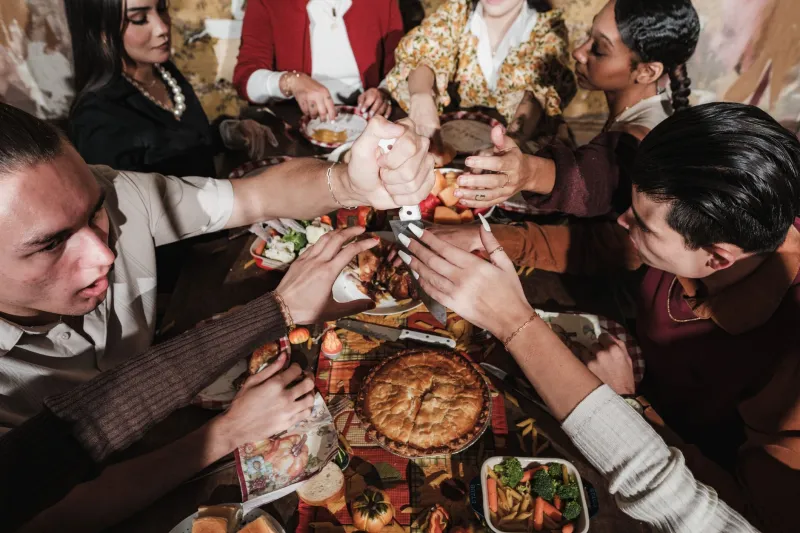
If there's one American holiday that Arab families have truly adopted and remixed, it's Thanksgiving. The format — a big communal meal centered on gratitude and family — maps almost perfectly onto Arab hospitality values. The execution, though, is where things get creative.
In many Arab-American households, the turkey shares the table with dishes that would make a Food Network producer do a double-take. Stuffed grape leaves next to the stuffing. A tray of knafeh where the pumpkin pie usually sits. Hummus as a side dish because, honestly, why wasn't it always a side dish?
Omar Khalil, a Palestinian-American food writer based in Brooklyn, has written about this phenomenon with a mix of humor and genuine affection. "There's something really powerful about taking a holiday that isn't originally yours and saying, 'We're going to participate in this, and we're going to bring everything we are to it,'" he told us. "The table gets bigger. The food gets better. Everyone wins."
He also points out that younger Arab-Americans are increasingly vocal about the complicated history of Thanksgiving itself — and that some families are using the holiday as a moment to talk about displacement, belonging, and what it means to be a guest on someone else's land. "Those conversations happen at a lot of Arab dinner tables," he says. "We know something about that history."
The Next Generation Is Writing the Rules
What's striking about this cultural remixing is how intentional the younger generation is about it. This isn't assimilation by default — it's curation by choice. Arab-American Gen Zers and young millennials are actively researching their family's regional traditions, learning holiday recipes from grandparents over FaceTime, and then posting the results on TikTok with captions that explain the cultural context to their followers.
They're also pushing back, gently but firmly, on the idea that honoring one culture means diminishing another. Lara Haddad, the teenager who designed those bilingual Eid invitations, put it simply: "I'm not half of anything. I'm all of both things. The holidays should feel like that too."
That sentiment is echoed in community spaces across the country — in mosques that host interfaith holiday events, in Arab-American student groups that throw Eid parties with a DJ, in family kitchens where a grandmother teaches her granddaughter to make maamoul while Christmas music plays in the background.
A Tradition in Progress
What Arab-American families are building right now isn't a finished product. It's a living, evolving set of practices that will look different in another generation — shaped by whoever is standing in those kitchens, lighting those candles, and setting those tables next.
But that's kind of the point. Traditions were never meant to be static. They were always meant to carry people forward.
For Arab-American families navigating two cultural worlds, the holidays have become one of the most honest expressions of who they are — not a compromise, and not a performance, but something genuinely new. A tradition that belongs to them, built from everything they've been given and everything they've chosen to keep.